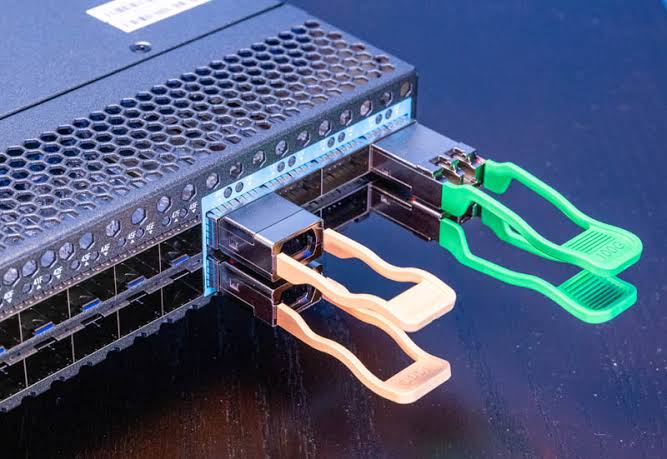
Where 100G IR4 Fits in a 100G Network Upgrade
Moving to 100G Ethernet is not simply a matter of replacing switches and transceivers. Network teams must also consider existing fiber infrastructure, link distances, cabling constraints, and future capacity requirements. For links around 2 km, a 100G IR4 transceiver can be a practical option, particularly when organizations want to upgrade bandwidth without redesigning their entire fiber plant.
Campus Networks: Upgrading Without Rebuilding the Fiber Plant
Campus networks often connect multiple buildings, distribution switches, and aggregation points across distances that exceed typical short-reach connections. Many sites already have single-mode fiber installed, but replacing or adding cabling can be expensive and disruptive.
A 100G IR4 module can help extend 100G connectivity across suitable existing single-mode fiber links. Its four-wavelength architecture carries the aggregate data rate over a duplex fiber pair, allowing network operators to use a familiar LC-based connection rather than deploying a parallel-fiber interface.
Before deployment, engineers should verify the fiber type, end-to-end link loss, connector condition, and the module’s specified reach. The physical distance alone does not determine whether a link will work reliably.
Building-to-Building and Data Center Interconnects
Connections between nearby buildings or separate equipment rooms often fall into a middle ground: they require more reach than short-reach optics but do not necessarily justify a longer-reach solution.
In these environments, QSFP28 IR4 may provide a useful balance between reach and infrastructure requirements. It can support aggregation links between network closets, campus distribution layers, or nearby data center spaces, provided the link remains within the module’s optical specifications.
Existing fiber availability is an important factor. If a duplex single-mode pair is already available, using it for a suitable IR4 link may avoid the need to install additional fiber strands. However, engineers should also account for patch panels, intermediate connections, and the optical power budget before finalizing the design.
IR4, FR1, or LR4: Which One Fits?
The best choice depends on more than the distance printed on a product page.
IR4 is worth considering when a link needs approximately 2 km of reach and the deployment benefits from a four-wavelength architecture over duplex single-mode fiber. It can be a practical fit for campus and building connections where existing fiber resources are available.
FR1 takes a different approach by carrying 100G over a single optical wavelength. Depending on the specific implementation, it may simplify the optical architecture, but compatibility, reach, and host-platform support must be checked against the product specifications.
LR4 is generally associated with longer-reach 100G links, commonly up to 10 km under applicable specifications. It may be more appropriate when the distance or optical budget exceeds what an IR4 module can support. Choosing LR4 for a much shorter link, however, should be based on actual engineering requirements rather than reach alone.
Plan for the Link, Not Just the Module
Before selecting a transceiver, network teams should confirm four things: the required data rate, the actual fiber route, the available optical budget, and compatibility with the switches or routers at both ends. They should also consider whether the link is part of a broader migration toward 400G or higher speeds.
A module that meets today’s distance requirement may not be the best fit if the network is expected to change significantly in the near future.
For suitable 2 km single-mode links, 100G IR4 offers a practical option for campus networks, nearby buildings, and data center connections. By evaluating existing fiber infrastructure and platform requirements first, network operators can make a more informed upgrade decision while avoiding unnecessary cabling changes and mismatched optics.