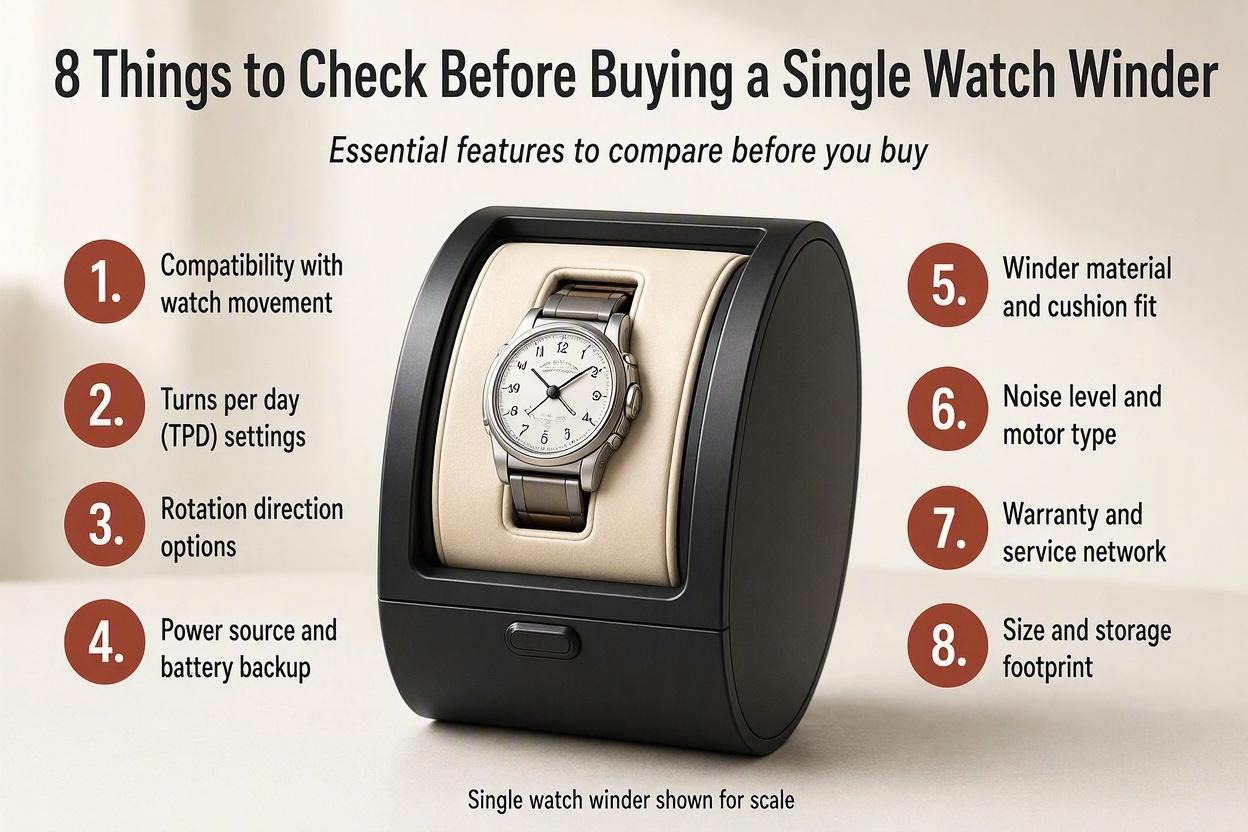
8 Things to Check Before Buying a Single Watch Winder
Buying a watch winder sounds simple until you actually start comparing models. Rotation direction, turns per day, motor noise, box materials — the specs pile up fast, and most product pages assume you already know what they mean. If you own one automatic watch and you’re trying to keep it running accurately between wears, here’s what actually matters before you spend your money.
1. Know Whether You Even Need One
A watch winder isn’t essential. If you wear your automatic watch most days, your own wrist movement keeps the mainspring wound and you can simply reset the time and date when you pick it up again. A winder earns its keep in two situations: you own a watch with a complicated calendar function that’s a hassle to reset (annual calendars, perpetual calendars, moonphases), or you rotate between watches often enough that any single piece sits idle for more than a few days at a stretch.
If neither applies to you, save the money. If either does, a winder stops the watch from running down and saves you from resetting a dozen date wheels every time you pick it back up.
2. Match the Turns Per Day (TPD) to Your Movement
This is the single most important spec, and the one buyers get wrong most often. TPD tells you how many rotations the winder makes each day, and it needs to roughly match what your movement’s manufacturer recommends — too few turns and the mainspring won’t stay fully wound; too many and you’re putting unnecessary wear on the automatic mechanism over years of use.
Most calibres fall somewhere between 650 and 950 TPD, but it varies by brand and even by model within the same brand. Rolex movements typically want a different setting than an ETA-based movement, for instance. Check your watch’s documentation or the manufacturer’s website for the exact figure — never guess, and never assume “more is better.”
3. Get the Rotation Direction Right
Automatic movements wind in one of three ways: clockwise only, counter-clockwise only, or bi-directional. A rotor that only turns one way to generate power is one of the more overlooked details in the whole self-winding mechanism, and it’s worth understanding how the rotor and mainspring actually interact before you pick a winder — Wikipedia’s rundown of the rotor and gear-train mechanism inside a self-winding movement is a genuinely useful primer if you want the mechanical detail.
Practically, this means a winder set to the wrong direction may do nothing at all, since it’s essentially spinning the rotor in a direction the movement can’t convert into stored energy. Always confirm your watch’s specific direction requirement before setting up the winder, and check whether the model you’re considering lets you choose or cycles automatically through all three.
4. Think About Motor Noise and Placement
A winder runs for a set number of minutes several times a day, indefinitely, usually in a bedroom or on a dresser. A motor with an audible whir or click is fine tucked away in a closet or another room, but it becomes a genuine annoyance on a nightstand. Look for reviews or spec sheets that mention noise levels in decibels, or Japanese-made motors specifically, which tend to run quieter than cheaper alternatives. If you’re placing it somewhere you’ll actually hear it, this matters more than almost any other spec on the list.
5. Check the Box Materials and Watch Cushion
The winder itself is a small piece of furniture that’s going to sit in view, so material quality affects both how it looks and how well it protects the watch. Solid wood, leather-wrapped, and piano-lacquer finishes hold up better over years than thin veneers or plastic shells that can warp or discolour. Inside, the cushion or pillow holding the watch should be soft enough not to mark the strap or bracelet, adjustable enough to fit different case sizes, and ideally removable for cleaning.
A watch winder that looks cheap after eighteen months usually was cheap to begin with — this is one area where paying a bit more up front tends to be worth it.
6. Decide Between Single and Multi-Watch Winders
If you own one automatic watch, a single winder is the obvious choice, and it’s usually the better value: you’re not paying for slots you’ll never fill. But it’s worth thinking ahead. If a second automatic watch is likely in your future, a compact multi-watch unit that winds each piece independently can work out cheaper long-term than buying separate single units later.
For most one-watch owners, though, browsing a dedicated range of single watch winders worth considering is the more sensible starting point — it narrows the field to models actually built for one watch, rather than sifting through multi-slot units with settings you don’t need.
7. Look at Power Options and Backup
Most decent winders run on mains power, but battery backup matters more than people expect — a power cut of even a few hours can interrupt the winding cycle, and depending on your watch’s power reserve, that’s sometimes enough to let it stop. Battery-powered or battery-backup models cost a little more but remove that risk entirely, which is worth it if the winder is doing a genuinely important job (keeping a perpetual calendar running, for example) rather than just a convenience.
8. Buy From a Brand That Stands Behind the Product
Winders are mechanical devices with moving parts, and like any motor, they can eventually fail. A one- or two-year warranty, responsive customer support, and a returns policy that doesn’t require jumping through hoops all matter more once something goes wrong than they do at the point of purchase. It’s also worth checking who’s actually behind the listing — a proper specification sheet, clear TPD and direction settings, and real photos of the internal mechanism are usually a good sign you’re buying from a retailer that understands the product rather than reselling generic stock.
This is also where brand reputation genuinely earns its place in the decision. Not every manufacturer builds motors to the same standard, and the difference shows up after a year or two of daily use rather than on day one. If you want a rundown of which manufacturers consistently hold up, it’s worth taking the time to learn more about how the established names compare before settling on a model.
Final Thoughts
A watch winder is a small purchase that’s easy to get wrong simply because the specs aren’t explained anywhere obvious. Get the turns per day and rotation direction right for your specific movement, and everything else — noise, materials, power backup, warranty — comes down to how and where you’ll actually use it day to day. If you’re still unsure which setting fits your particular watch, the team at Aevitas is generally happy to help match a winder to your movement before you buy, which is worth doing once rather than guessing and returning the wrong unit.
FAQs
Do I need a watch winder if I wear my watch every day? Not usually. Daily wear keeps most automatic movements sufficiently wound on its own. A winder is more useful for watches you wear only occasionally or that have calendar complications that are tedious to reset.
What happens if the TPD setting is wrong for my watch? Too low, and the mainspring may not stay fully wound, causing the watch to run down or lose accuracy. Too high, and you’re adding unnecessary long-term wear to the winding mechanism, though this effect is gradual rather than immediate.
Can a watch winder damage my watch? Used correctly, with the right TPD and rotation direction for your specific movement, a winder is safe for long-term use. Damage risk mostly comes from using the wrong settings for years on end, not from the winder itself.
How long should I run a watch winder each day? Most winders are pre-programmed with cycles that include rest periods rather than running constantly, which mimics natural wear more closely than nonstop rotation. Check the manufacturer’s default cycle rather than assuming continuous winding is better.
Is a single watch winder worth it for just one automatic watch? Yes, if that watch has a complicated calendar or you don’t wear it daily. For a simple three-hand automatic worn most days, it’s more of a convenience than a necessity.